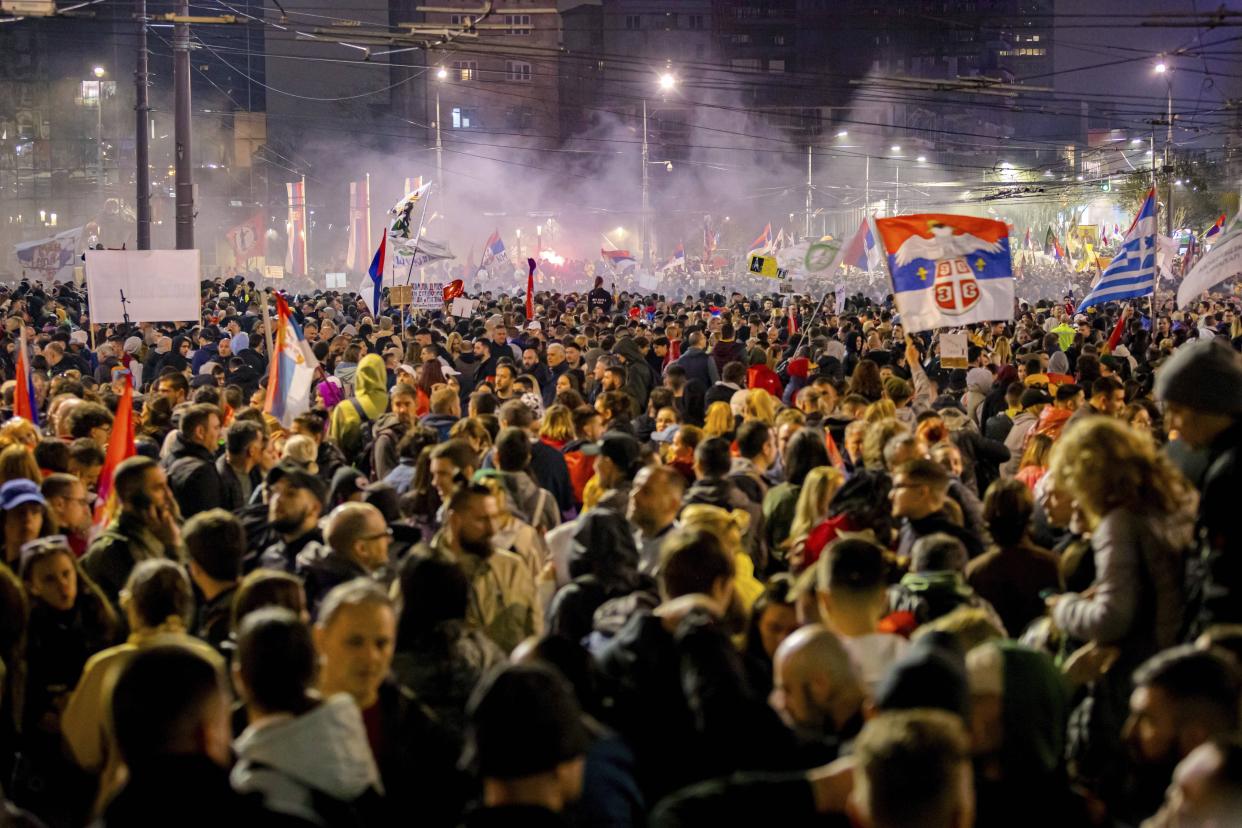
Serbia’s government appears to be at a crucial juncture in handling the country’s domestic crisis and navigating its EU future. On October 29, the European Commission is scheduled to present its annual enlargement package, which will include a progress report on Serbia’s accession path. A few days later, on November 1, major rallies are expected across the country to mark the first anniversary of the tragic construction disaster that triggered persistent nationwide protests. Both dates present inflection points in this crisis that deserves far more political attention in Berlin and other EU capitals than it has gotten so far.
The Vucic administration is now testing the reactions of its EU partners – and the loyalty of its own police commanders – before it moves ahead with a larger, more ambitious and heavy-handed crackdown on the protests. We argue that EU leaders, particularly the new German government, need to take recent signals from Belgrade much more seriously and deter the Serbian president from proceeding with a more heavy-handed crackdown and violence.
Origins of Widespread Discontent
As nationwide protests in Serbia continued after the summer, the government changed its approach by increasing its number of detentions and use of violence. For almost two weeks in August, riot police were deployed in full scale against protesters who were also attacked by hooligans organized by the country’s ruling party, the Serbian Progressive Party (SNS). On August 12, the use of violence escalated when demonstrations moved in front of SNS offices in Novi Sad, Serbia’s second-largest city, where that tragic construction disaster took place at a railway station in November 2024 that claimed 16 lives and ignited this student-led protest movement. Initially, the young protesters demanded a full investigation of the tragedy that they saw as resulting from endemic corruption and state failure under the rule of SNS, the party that has dominated Serbian politics for more than a decade. Signaling a generational change in both focus and values, these demands evolved into broader calls for snap elections that the government categorically rejects.
The administration of Serbia’s populist leader, President Aleksandar Vucic, accompanied its August crackdown with intensified propaganda that portrayed the demonstrators as being instigated by foreign actors and responsible for causing the chaos and violent confrontation. On the one hand, this was an attempt by the government to weaken public sympathy for the protest movement and justify its harsh crackdown. On the other hand, it was done to test external reactions: namely, how much repression would Serbia’s Western partners – particularly those throughout the EU, which the government still claims it aspires to join – continue to accept? The administration’s repressive actions were also timed to take advantage of August distractions, including widespread summer holidays and the Trump-Putin summit in Alaska that grabbed international attention. While critical reactions from EU capitals and the media have seemed to convince Vucic to backtrack on the scale of violence used, the situation remains fragile. On September 5, violent clashes erupted again with anti-riot police making multiple arrests and using excessive force, including against visibly marked journalists.
President Vucic’s Legitimacy Crisis
Much of the public narrative and internal discontent is being shaped by the students’ call for snap elections – which President Vucic categorically rejects. While he allows that the national elections regularly scheduled for 2027 could come earlier, he insists they will not take place before late 2026. Vucic is currently focused on preparing for Expo 2027, a flagship project for foreign investment that he sees as his political legacy (and in which Germany has agreed to participate). To realize this project effectively, internal consolidation and parliamentary elections need to be out of the way by latest end of next year. However, for the first time in the 13 years that it has been in power, SNS – including Aleksandar Vucic – is electorally vulnerable. According to recent polling by the Center for Research, Transparency, and Accountability (CRTA), President Vucic’s support dropped to around 40 percent from 55 percent a year ago. The data show that 53.5 percent of Serbs believe their country is moving in the wrong direction, while just 33.5 percent expressed optimism about its future. This poll also indicated a growing appetite for change, with some 55 percent of respondents supporting the nascent “student candidate list” – a heterogenous coalition comprised of professors, students, trade unions, farmers, and experts – compared to 42 percent backing Vucic’s coalition around SNS.
In early June, SNS scored narrow victories in local by-elections in the two small municipalities of Zajecar and Kosjeric. Yet, the ruling party only achieved them by fully mobilizing state and financial resources, and numerous irregularities were reported during the electoral process. Such results are a reminder that, even as the ruling party is on the defensive, it still has huge assets. These include campaign finances and control over local structures and many other levers of power throughout the country.
Limited Space for Action
So far, Vucic has operated on the assumption that the protest movement will eventually burn out and lose public support. Previous protests – for example, those against lithium mining in 2021 and after a mass shooting in 2023 – have shown SNS leadership that it can withstand popular unrest. Yet, this time, public discontent runs much deeper. Trust in Vucic and the SNS voter constituency is more eroded. A highly polarized society wants more substantial change, especially in governance.
President Vucic’s cardinal problem is that he can neither solve Serbia’s underlying problems nor offer genuine political concessions. His political future and personal security are intricately and directly linked to the future of the system he created. So far, his crisis management has consisted of constant improvisation while he prioritizes keeping the power structure intact over risky political reform or concessions. Tactical retreats are possible – as the resignation of Prime Minister Milos Vucevic in early 2025 in an attempt to appease early protests shows. Yet, this was only a cosmetic government reshuffle. Vucic prefers consolidating his camp to bringing in more technocrats or moderates who would bolster political dialogue and potentially create cracks in his system. The strongman is adamant about avoiding any moves that would undermine his own power and its financial base, driving further divisions. Under this logic, Vucic cannot allow even incremental political change, such as the opposition candidate rightfully becoming mayor of Belgrade or the approval of a full investigation of the tragic incident in Novi Sad. Such a change to the current system of governance would directly threaten his political power and eventually perhaps even his personal survival – as well as that of his brother Andrej who is informally the second most powerful person in the party and allegedly linked to organized crime structures.
Formally, SNS is still committed to the EU accession process on which it relies to reassure foreign investors and Western partners. Until recently, the ruling party has used the mantras of economic growth (backed by untransparent new investments) and increased nationalism to appeal to its voters. But if it now goes even further toward a full-scale reversal of democratic standards – essentially the “Erdoganization” of Serbia – this would effectively strangle the EU accession of a small integrated economy that is dependent on EU trade and capital. Moreover, such a move has the potential to turn Belgrade into a spoiler of EU enlargement for the whole fragile region, playing into the hands of Russia. From the beginning, Moscow framed Serbia’s student protests as an attempt at another “color revolution” organized from the West. Meanwhile, this has also become the official narrative in Belgrade that drives the government’s propaganda.
Relying on Geopolitical Balancing and Playing the EU
Growing power rivalry on the global stage and Russia’s war against Ukraine in Europe have created more room to maneuver for regional and midsize countries such as Israel, Turkey, and Azerbaijan. President Vucic has been adept at exploiting this space for Serbia, making sure to offer all stakeholders something but, crucially, not giving too much to anyone.
Geopolitically, he has combined cautious “Western engagement” – including through the EU accession process and stable relations with the United States and NATO – with a multi-vector foreign policy that relies on maintaining good relations with Russia and China by employing constant “hedging” and balancing to keep room to maneuver. Brussels and Paris continue to view Vucic as a stabilizing factor in a volatile region on the EU’s periphery, which is becoming even more fragile under a disengaged United States, relying on the local strongman to continue supplying ammunition to Ukraine or to develop lithium mining. Berlin does too – although it has been more critical, particularly under the previous government led by Chancellor Olaf Scholz. At a time when European diplomats are urgently trying to ease the conflicts in Ukraine and Gaza and negotiate on trade with the administration of US President Trump, dealing with yet another looming crisis in the Western Balkans is an afterthought for many foreign ministers.
Yet, Brussels will soon have to make its next careful move around the Serbian crisis when it presents its annual enlargement package, which will include a progress report on Belgrade’s accession path. After consultations with civil society organizations, the Serbian government has promised to pass selected legislative changes related to improving electoral integrity and media oversight to keep its EU accession open. Although reforms in other areas have practically stopped, these are required by the European Commission.
One argument for the EU to accept such narrow technocratic logic from Belgrade is of a tactical nature: it could allow Serbia to continue on its path to the EU to keep it from acting as a spoiler on the accession process for the whole region. And if Bosnia was upgraded into accession talks last year without reaching criteria, why be so strict about its larger and more relevant neighbor? Brussels has applied this convenient logic toward Serbia time and again, causing President Vucic and his ruling SNS party to take it as a norm. Yet, doing so again would be a grave mistake. Therefore, Germany’s new CDU-led government should use its backdoor access to SNS – its sister party in the European People’s Party (EPP) – to convey its readiness to assess the party’s membership.
To prevent such a mistake, the European Commission needs to take a more political approach rather than a technocratic one. The speech of Enlargement Commissioner Marta Kos at the European Parliament on September 9 can be seen as a good first step. In it, she noted that “intimidations and pressure on civil society is not the way we operate in the Union.” Further, if Belgrade fails to de-escalate the domestic crisis, the EU Council is unlikely to approve the opening of Cluster 3 on the economy and internal market – despite Serbia’s formal compliance with the benchmarks. For contrast, Albania, which started EU accession talks almost a decade later than Serbia, recently opened those same chapters that lead to integration into the European single market. Thus, Brussels is confronted with a dilemma of its own making: how can the EU continue to upgrade countries while it deepens the gap between accession frontrunners in the Western Balkans and a regional hegemon with leverage to obstruct the progress of Serbia’s neighbors (especially Montenegro with its large ethnic Serb minority)?
Germany Needs to Help the EU Change Its Approach
Instead of relying on President Vucic’s “crisis management” in the region and autocratic resilience at home, the EU and Germany must better understand his limits and vulnerabilities. They need to prepare for a more unpredictable and restless Serbia under his (remaining) rule by making political freedoms the foundation for advancing its EU accession.
On the regional level, Serbia is turning from a factor of stability to a beacon of regional instability. While EU leaders are busy sorting out their own issues, Serbian society is becoming a case study on democratic resistance within the Western Balkans in the illiberal era of US President Trump. Given Vucic’s participation in the anti-Western, anti-liberal global gathering in China in early September – at which he held bilateral meetings with world’s major autocrats – EU leadership should reassess its approach to this membership candidate country more seriously.
Therefore, the new German government should:
- Intensify its internal discussions within the EU Council with like-minded Nordic countries, Austria, and Slovenia to obtain a strict but fair annual country report on Serbia, doubling down on rule of law and fundamentals. This would serve as the basis for future political dialogue with President Vucic and for restoring lost EU credibility with Serbian society.
- Support the European Commission in accelerating accession with those Western Balkan candidates that are reforming. This includes elaborating the concept of “small enlargement,” focusing on Montenegro and Albania while keeping doors open to Serbia in case of political reforms. Such a bold approach is the best incentive for Belgrade to take EU conditions more seriously rather than merely relying on Serbia’s size, geopolitics, and the uncritical support of some EU member states to move it forward on its EU path.
- Make a visit to Belgrade by Federal Foreign Minister Johann Wadephul during his upcoming trip to the region dependent on the de-escalation of the domestic situation in Serbia. The CDU-led German government should also take a more active moderating role ahead of the December European Council, using its party contacts with SNS within the EPP as a back channel. Essentially, to prevent a heavy-handed crackdown and save Serbia’s EU perspective, the government of Chancellor Friedrich Merz needs a more calibrated strategy on the Balkans and Serbia.
- Help the European Commission to prepare critical dialogue with Belgrade on gradual integration into the single market and fundamentals. In this context, the Commission should leverage the €1.6 billion in funding that is allocated for Serbia in its Growth Plan for the Western Balkans more firmly. Following recent crackdowns, Brussels must make all further disbursements conditional on credible democratic reforms. It must avoid releasing funds, as it did in July, despite hinting it might not.