Three relevant factors are ignored: First, an extreme spike in arrivals during the summer of 2023, driven by worsening conditions and rumors of tighter controls, is a statistical anomaly that exaggerates the deal’s success. The subsequent decline is more a return to normal than a policy triumph. Second, Rome has been a key player, forging close ties with Tunis and providing direct support. Third, President Kais Saïed’s measures to reduce migrant departures is motivated more by internal pressures and social tensions than by European incentives. With the EU replicating the Tunisia model in Egypt and beyond, it is essential to provide a more nuanced explanation for the drop in irregular arrivals and to address the deal’s serious shortcomings: a lack of transparency, disregard for human rights, and the risk of legitimizing political repression.
European Commission President Ursula von der Leyen is convinced that the EU-Tunisia deal on migration, two years after its conclusion, has delivered a clear success: 80 percent fewer irregular arrivals in Italy from Tunisia. For von der Leyen this decline is directly related to the controversial deal. She sees it as proof that her approach of cooperating with transit states in the EU’s neighborhood has been effective and is using the deal as a blueprint for further agreements.
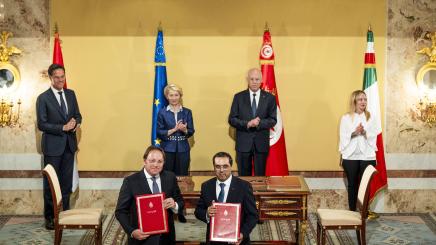
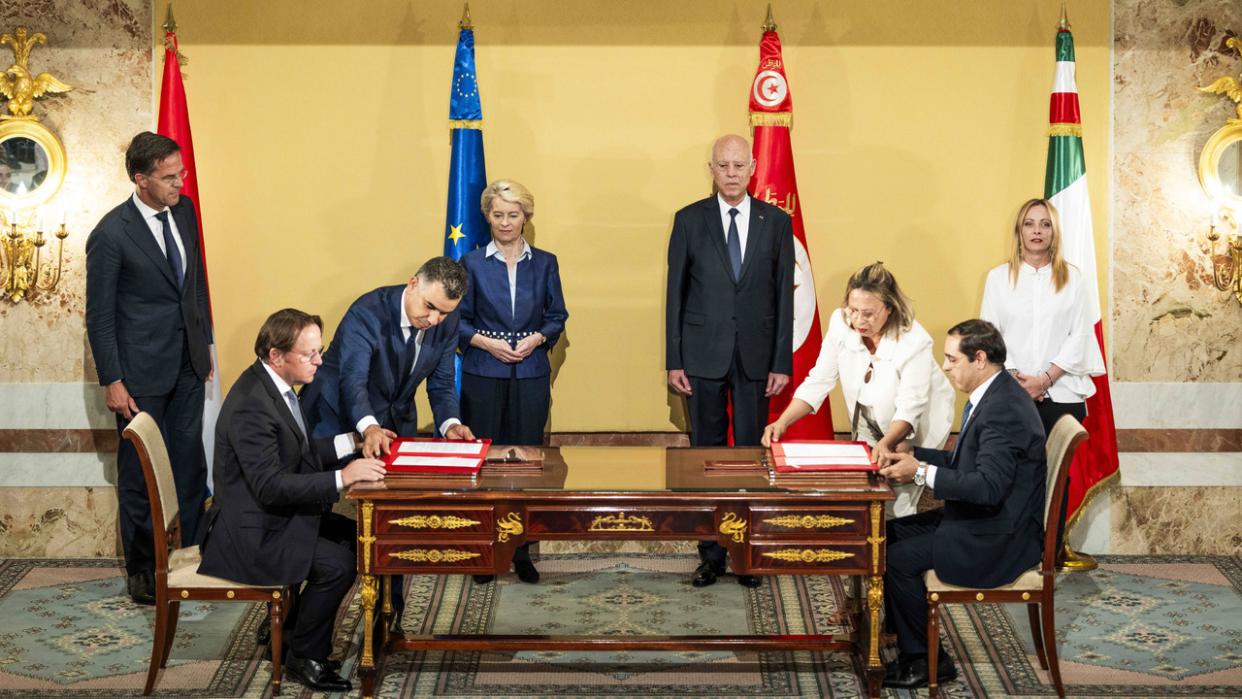
The deal is a so-called comprehensive memorandum of understanding, in which the EU and Tunisia agreed to closer collaboration across several sectors. Migration is just one of five pillars, but it is here that the most visible changes have occurred since the agreement was signed. The EU, for example, provided financial resources to strengthen Tunisia’s border controls.
However, the impact was not immediate. Directly after the MoU was signed, from July to September 2023, departures from Tunisia were particularly high: almost 60,000 people reached Italy from Tunisia in these months alone – two-thirds of the 2023 total. Only from October onward did the number of arrivals on the Central Mediterranean route begin to decline. Why did it take three months for this supposed success to materialize? One frequent explanation is that implementation took time. The €105 million in EU funds pledged for migration had to be disbursed and invested. Equipment for the Tunisian coast guard, return programs, technical training – all of this could not take effect overnight.
However, this explanation ignores three factors that are just as relevant to the decline in numbers.
Summer 2023 Skewed the Numbers
First, the summer of 2023 was an outlier. The spike in departures came at a time of drastically worsening living conditions, increasing violence against migrants, and rumors that stricter controls at the ports were imminent. Many migrants may have seen it as their last chance to leave and set out across the Mediterranean despite all risks. The result was a statistical spike that makes subsequent developments appear more dramatic than they are. In the months that followed, the sense of urgency faded, the weather worsened with the season, and the number of crossings dropped sharply. The sudden decrease, thus, is less a result of the deal than a correction of an exceptional situation.
The Rome-Tunis Connection
Second, the most influential player in European-Tunisian relations has not been Brussels, but Rome – not only because of the two countries’ geographical proximity. Italian officials have maintained a close and consistent dialogue with their Tunisian counterparts, with Italian visits to Tunis occurring on a near-monthly basis. The relationship between Prime Minister Giorgia Meloni’s government and President Kais Saïed has grown notably warm, marked by frequent high-level meetings. Italy has offered incentives to cement this partnership, including boats for the Tunisian coast guard and expanded opportunities for seasonal work visas, and has largely refrained from criticizing human rights violations. In exchange, Tunis has demonstrated a willingness to cooperate, particularly by curbing the number of sub-Saharan migrants departing for Europe.
Fewer Departures Are Also in Tunisia’s Interest
Third, Saïed has his own reasons for preventing departures from his country. He regularly emphasizes that Tunisia neither wants to be a transit country nor a destination for migration. The president’s harsher rhetoric and the growing number of migrants have led to tensions between migrants and locals, especially in the region around Sfax. Many migrants have had to live in makeshift camps, including in olive groves, often without adequate shelter, supplies, or access to services. The Tunisian government has responded with a heavy hand, restricting the work of aid organizations, clearing camps, and, according to reports, stepping up expulsions to border regions. In doing so, Tunis also sought to send a message to potential migrants: the route through Tunisia is no longer an option.
A Deal with Shortcomings
Tunisia’s self-interest, Italy’s bilateral cooperation, and statistical distortion explain the sharp decline in arrival numbers in the EU more comprehensively than the EU-Tunisia deal on its own. Nevertheless, the European Commission continues to present the deal as a blueprint for further cooperation, for example with Egypt, where the EU closed a similar deal in March 2024.
The Commission should revise its blueprint in two ways.
First, it should not celebrate the decline in arrival numbers as an outcome of the deal without acknowledging the three other causes. Since the purported effects of the deal also depend on factors largely beyond the control of the EU, honest and transparent communication needs to openly acknowledge both the necessity of cooperation with challenging partners on migration and the inherent limitations of such partnerships.
Second, the Commission should address the serious weaknesses of the deal instead of overstating its success and using this narrative to dismiss legitimate criticism of the agreement. To this day, there is insufficient transparency regarding when and how funds have been spent. In addition, numerous reports of human rights violations, including the forced expulsion of migrants into the desert, have not resulted in the suspension of funding or cooperation with Tunisian border authorities. Moreover, the EU has faced accusations of legitimizing political repression, for example when it failed to publicly oppose the imprisonment of 37 political opponents, lawyers, and civil society representatives in April 2025.