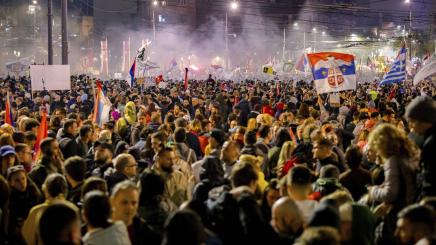
For more than a decade, the nationalist leader Milorad Dodik had consolidated his power and tested the international community’s red lines by pushing Republika Srpska (RS) – the Serb entity within Bosnia and Herzegovina – toward secession. On August 18, Bosnia’s Constitutional Court issued a verdict that revoked Dodik’s mandate as president of RS, banned him from holding public office for six years, and marked an end to his secessionist ambitions. In a new political landscape shaped by Russia’s war of aggression against Ukraine and global instability, Dodik failed to win support for full-scale separatism from his key allies, Hungary, Serbia, and Russia. His attempts to cater to the second administration of US President Donald Trump also yielded no results. He miscalculated a geopolitical moment when the transatlantic normative and security architecture remains committed to guaranteeing Bosnia’s territorial integrity and sovereignty.
Constrained internationally and cornered at home, Dodik is now at the weakest point of his political career. Although he called for an October 25 referendum on the Constitutional Court’s verdict against him, it seems unlikely to succeed. On September 25, the parliament of RS withdrew its objection to holding early presidential elections on November 23. The conduct and outcome of these elections will show how strong Dodik’s party, the Alliance of Social Democrats (SNSD), still is. They will shape a new era in the balance of power between the RS entity and the Bosnian state, setting the stage for general elections scheduled for October 2026.
As politics in RS transition into a post-Dodik phase, Bosnia will face more instability until these general elections take place. While there is no acute security crisis, European leaders should not underestimate a moment that has the potential to destabilize the fragile Western Balkans and present further geopolitical challenges to the EU. This pivotal time demands that more international attention be focused on crafting a more functional Bosnian state. As the EU’s largest member state and a leading donor in Bosnia and Herzegovina (BiH), Germany will need to increase its engagement in the country – through both its own government and the office of the High Representative – to preserve regional stability and help it navigate its European future.
International Fix/Local Problem
The treaty that ended the Bosnian War – known as the Dayton Peace Agreement – was negotiated in 1995 under the auspices of key Western powers. These negotiations included close facilitation and agreement with Russia, which was very much driven by the United States whose attention to the region is now fading. Despite radical shifts in the international order that had held since the end of the Cold War, there has been no change of policy to allow for the breakup of Bosnia. Yet, while the country enjoys international sovereignty, it lacks complete internal control over its affairs. Bosnia is still under the supervision of the ad hoc international institution of the Office of the High Representative, which is now led by Christian Schmidt, a German politician from the Christian Social Union (CSU), the sister party of Chancellor Friedrich Merz’s Christian Democratic Union (CDU).
Domestically, three parties – representing Bosniaks, Croats, and Serbs – each seek different ways to reform the state while they all proclaim their commitment to joining the EU. The Bosniaks, with the largest population, seek a centralized state in line with the EU accession process. The Croats wish to form an autonomous third entity. The Serbs aim to preserve their autonomy inside a weak Bosnia, with some preferring a separate state or merger with Serbia.
The EU membership bid of the Bosnian state is both a blessing and a curse for renegotiating its future. The transfer of competencies from the entity level – primarily from the RS entity but also from the Federation BiH entity – to the central state level of Bosnia inherently endangers the power of all ethnic leaders. The “Bonn Powers” of the High Representative, meant as a last-resort tool to enforce laws or remove officials, persist three decades after Dayton. Further, the European Court of Human Rights appoints three international judges to sit on Bosnia’s Constitutional Court. Serb leadership skillfully instrumentalizes this fact to undermine its legitimacy.
Dodik has failed to turn his rhetoric and laws into de jure secession
The confrontation between RS President Dodik and High Representative Schmidt began with Schmidt’s appointment in 2021. Dodik used the occasion to broadly challenge the authority of international supervision. Fearful of losing power and empowered by the diversion of European attention from managing the Western Balkans to Russia’s war on Ukraine, Dodik passed laws in the National Assembly of the Republic of Srpska that suspended the rulings of Bosnia’s Constitutional Court (CC) and prevented the publication and implementation of the High Representative’s decisions. Dodik has also introduced laws to block the operation of Bosnia’s state courts and state police within RS territory and drafted a new RS constitution. Crucially, his attempt to withdraw Serb officials from Bosnia’s state-level institutions failed, and the only fully functioning and implemented RS institution is an administrative office of the “Medicines Agency.” All other laws have been annulled or suspended by Bosnia’s CC. These judicial rulings have placed the question of local versus international ownership at the center of the country’s politics. Local elites and their international allies defy the West for keeping Bosnia under neocolonial rule, yet they refuse to accept that most EU member states that empower the foreign rule do so to keep the country functional.
A Chance for RS Opposition
After first contesting the CC’s August 18 verdict, Dodik de facto left office on September 19 when he transferred RS presidential authority to his deputy. Even his long-time ally Dragan Čović, the leader of the Croatian Democratic Union of BiH (HDZ-BiH) party, has publicly called for respect of judicial rulings and acknowledged that the RS presidency is vacant. In a tripartite system like Bosnia’s, losing the support of a key ally is a costly setback. Dodik has failed to turn his rhetoric and laws into de jure secession. This ultimately underscores how important international support and the High Representative have been to safeguarding Bosnia’s integrity and containing Dodik’s secessionism.
Against this background, how will November’s elections impact politics in RS and the country as a whole? The early presidential elections offer the Opposition a chance to break the grip on power that SNSD has had since 2010. While all parties initially renounced participation in these elections, they have since realized that boycotting them would put them in a similar position to the Serbs in Northern Kosovo who now find themselves without representation. However, the Opposition in RS is fragmented. The four major parties that comprise it have not yet been able to think beyond their own interests to rally behind a common candidate. The most promising option would be to offer joint support to Branko Blanusa, the candidate of the Serb Democratic Party (SDS).
Western powers remain united in safeguarding Bosnia
Widespread irregularities, electoral manipulation, media that is controlled by the ruling party, and a mobilized loyalist electorate make the upcoming elections highly contentious and leave the challengers at a clear disadvantage. The Opposition parties have all denounced the corrupt, nationalistic rule of Dodik for the past decade and are intent on advancing Bosnia’s EU path. Regardless of the outcome of the early RS presidential elections, political polarization and instability in Bosnia are likely to deepen. No matter how SNSD fares, the results will shape the campaign narrative for the more important general elections in 2026. While secession is no longer an option, a SNSD victory would embolden nationalist rhetoric and disruptive politics. A defeat could trigger disputes over legitimacy and create a toxic environment.
Testing the Limits of International Politics Around Bosnia
In frustration over his dwindling power, Dodik turned to Moscow to seek support for his referendum on the Constitutional Court’s verdict against him and for vetoing Operation ALTHEA of the European Force in BiH, which is mandated by the UN Security Council. In response, Russian Foreign Minister Sergey Lavrov only issued support for the territorial integrity of Bosnia in its original Dayton form. Looking to the West, Dodik was publicly rebuked by US Secretary of State Marco Rubio in April for undermining stability in Bosnia. Also, his party colleague Zeljka Cvijanovic, the Serb member of the Bosnian presidency, failed in her bid to convince the current administration in Washington to ease sanctions on her and Dodik, making SNSD’s bet on a policy reversal on RS under the second Trump presidency a failure. In Brussels, Dodik’s ally Hungary may undermine EU unity by obstructing the Council of the European Union on imposing sanctions on RS officials (for which unanimity is required), but this has not stopped member states such as Poland, Lithuania, Estonia, Austria, Germany, and Slovenia from imposing unilateral travel bans. While Western powers diverge on how to address many of the world’s hotspots, they remain united in safeguarding Bosnia and strengthening its institutions.
Regionally, Serbian President Aleksandar Vucic has extended financial and political support to RS but has shied away from elevating Dodik’s ambitions for separatism. While Vucic is pursuing a non-recognition dispute with Serbia’s former province Kosovo, he is not so naïve as to risk his political capital with the West by moving to unite all Serbs in one country – a concept derived from Russkiy mir. As Vucic is under increasing pressure at home, it is not in his government’s interest to contribute to a security crisis in Bosnia. Following similar logic, there is still international consensus on prolonging EUFOR’S Operation ALTHEA peacekeeping mission because Western powers prefer keeping the current security arrangement and they will not allow a power vacuum to form. Furthermore, Russia is not willing to risk a potential return to a NATO-led mission. In 2022, Germany reacted to the return of war to the European continent and instability in both Kosovo and Bosnia by expanding its engagement in Bosnia through restarting its participation in the EUFOR mission. Despite the lack of viable engagement in the Quint by the United States, the other four members of this informal decision-making group – France, Germany, Italy, and the United Kingdom – remain strongly engaged. The Quint has signaled to Dodik that it will not allow a new security crisis in the Western Balkans.
Years of perpetual crisis and paused accessions have undermined the EU’s enlargement policy and credibility in the Western Balkans. Therefore, when the EU granted candidate status to Bosnia in 2022 amid renewed momentum linked to Russia’s aggression in Ukraine, it did so to send a geopolitical message to Moscow about its rising malign influence in this divided country. The move was also made to increase the European Union’s leverage over the government of RS, which had begun distancing itself from the EU under Dodik.
Bosnia has advanced integrity laws and border control measures that enable cooperation with Frontex, but accession talks remain paused. The Council of the EU insists that core judicial reforms and the appointment of a chief negotiator for EU accession are required before opening negotiations. Currently, both HDZ-BiH and SNSD maintain an ethnic veto on such developments in the House of Peoples, Bosnia’s upper parliament. Although each party uses the veto for a different purpose, both are against the reforms required by the EU. Under its long-time leader Covic, HDZ-BiH makes state-level reforms conditional upon electoral law changes to entrench its dominance in Bosnia’s federal government. Meanwhile, SNSD blocks state-level operations to render the state dysfunctional. After Dodik’s SNSD blocked key laws and the reform plan needed to unlock funds from the EU Growth Plan for the Western Balkans, pro-Bosnian parties ended their coalition with SNSD to find alternative partners, including from the RS Opposition. Thus, how the RS Opposition fares in November’s early presidential elections will also be an indication of the results that next year’s general elections could bring and whether a new pro-European government is realistic.
Recommendations for Germany and the Way Ahead
- The German government of Chancellor Friedrich Merz is committed to strong engagement in international affairs. Consequently, it should proactively leverage the direct access to High Representative Christian Schmidt that the ties between the German parties CDU and CSU afford it – taking the lead in the Quint format to ensure political support for Schmidt’s agenda. The government in Berlin should keep the administration in Washington engaged while stepping up its own role to fill the power vacuum in the Western Balkans and ensure that the United States upholds European interests there.
- If German Foreign Minister Johann Wadephul visits the enlargement front-runners in the region this fall, he should spend time in Bosnia. There, he should reaffirm Germany’s support for early elections and the country’s territorial integrity, sovereignty, and independence.
- Together with the Friends of Western Balkans and within the EU, Germany should seek a statement at the EU’s Foreign Affairs Council addressed to High Representative for Foreign and Security Policy Kaja Kallas. This statement should call for full respect for judicial rulings and the participation of all parties in the RS presidential elections in November. It should also denounce Dodik’s illegal referendum should it happen.
- Germany is a key actor in shaping the EU’s enlargement policy together with long-standing support from the United States and the United Kingdom. While supporting High Representative Schmidt in the short term, the German government should rally a critical mass of EU member states to develop a common approach to rethinking Bosnia’s international supervision. Because the period until general elections in fall 2026 will be volatile, Berlin should encourage all parties to enter a dialogue on how they envision the incremental and gradual process of adopting key reforms. This would include finalizing state property appropriation and, crucially, restoring the functionality of democratic institutions by decreasing ethnic veto opportunities as part of the accession fundamentals.
- Enlargement Commissioner Marta Kos’s visit to Sarajevo on September 23 – coupled with the allocation of European funds to civil society organizations affected by the withdrawal of USAID support – was a good first step. Now, a more strategic engagement should follow, including tailoring an approach to help Bosnia’s economy if it is unable to agree on the Growth Plan reform agenda. In any case, the EU should publicly identify those responsible for the blockage. Further and contingent on progress in minor reforms, it could redirect financial assistance to Bosnia and its citizens by funding socially relevant projects at the level of the Bosnian state and the Federation BiH entity.
- Together with the government of the United Kingdom, EU governments should raise their level of political attention to the 2026 general elections and increase pressure to enable electronic voter identification and the transparent and orderly counting of ballots. In this context, they should allocate special funds to support the press in Republika Srpska’s captured and homogenized media landscape to prevent the further spread of disinformation and inflammatory rhetoric.
The author wishes to express his gratitude for valuable comments to Milan Nic.