| Albania’s EU accession is advancing rapidly, backed by strong public support within Albania, geopolitical alignment, and PM Rama’s active diplomacy |
| Key reforms remain pending and require broader inclusion of civil society, local governments, the private sector, and the political opposition |
| Stronger domestic ownership and more rigorous EU scrutiny are needed to ensure credible, lasting progress as Albania enters a decisive phase of accession |
Below you will find the introduction of the publication without footnotes. Please download the PDF version here or on the top right to access the complete text with all footnotes.
Albania’s limited political pluralism and modest EU accession engagement from civil society, the private sector and local governments raise concerns about the sustainability and inclusiveness of reforms. Key reforms on media regulation, judicial reform, environmental protection and public procurement are still pending. This policy brief assesses Albania’s political dynamics and reform trajectory. It argues that insufficient EU due diligence on key reforms risks weakening the EU’s transformative power. Ensuring credible progress requires stronger domestic ownership and more rigorous and sincere EU assessments as Albania enters a decisive phase of accession.
Introduction
After enlargement gained renewed momentum following Russia’s invasion of Ukraine, the process has, three years on, come under significant strain in most Southeast European candidate countries. That is with the exception of Albania and Montenegro. Albania, in particular, is advancing in the accession process at an unprecedented pace, having opened all six negotiation clusters in just over a year.
However, in order to continue negotiations at full speed, Tirana first needs to meet the so-called interim benchmarks under the fundamentals cluster – a precondition to start closing the first negotiation chapters. The objective of doing so by the end of 2025 demands a serious political and societal commitment. The European Commission considers Albania’s overall goal of concluding membership negotiations by the end of 2027 as ambitious but ‘on track’, if it maintains its reform momentum and fosters ‘inclusive political dialogue’.
Albania’s recent progress on its EU integration path can be described as a success story.
Prime Minister Edi Rama, himself an artist by background, aspires to turn Albania into a model “artwork” of EU integration. Yet, unlike individualist artistic creation, EU accession requires a comprehensive, whole-of-society effort – something that is difficult to achieve in a highly centralised system. This policy brief examines Albania’s political dynamics and reform trajectory, assessing the current state of the country’s EU accession process and identifying critical political and technical reform hurdles. The analysis draws on findings from a scoping mission to Tirana conducted in early October 2025 by a consortium of four European think tanks which have been dedicated to researching EU enlargement with the Western Balkans for many years.
Unprecedented dynamism in Albania’s EU accession path
At face value, Albania’s recent progress on its EU integration path can be described as a success story. The country is one of the few candidates to demonstrate both a strong government push for and a broad public embrace of the EU path. With the experience of a harsh communist past and subsequent slow democratic transition still in mind, the Albanian government and society alike seem to sense a unique window of opportunity to make the country an EU member, riding on a wave of EU goodwill and geopolitical momentum.
Albania’s firm anchoring in the Western geopolitical camp also works to its advantage: Albania has been a NATO member since 2009 and fully aligns its foreign and security positions with the EU, including sanctions against Russia. Albania will host NATO’s 2027 summit, having already organised a 2022 EU-Western Balkans Summit and the European Political Community (EPC) gathering in May 2025. What is more, the country currently faces no major regional or neighbourly issues of the kind that have obstructed other Western Balkan candidates.
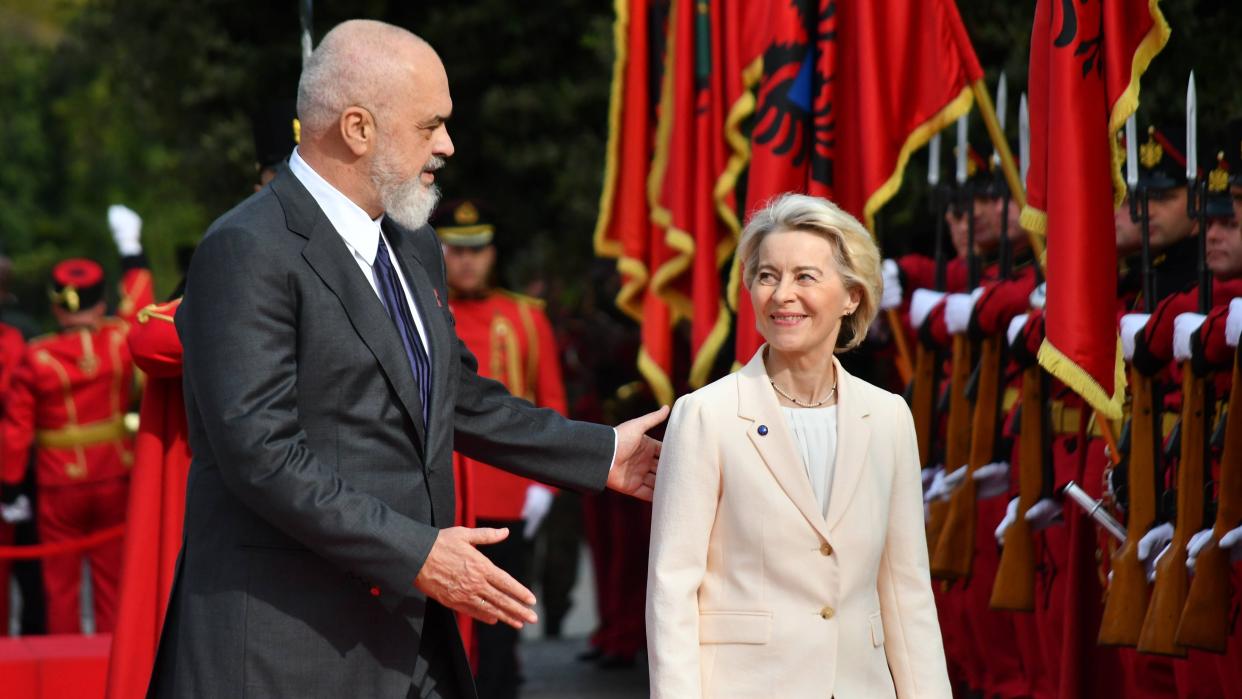
A key figure in these developments is Prime Minister Edi Rama. He has skilfully cultivated relations with key EU leaders in the EU institutions and Member States. Drawing on personal ties with the likes of “Emmanuel” (Macron), “Giorgia” (Meloni), and “Ursula” (Von der Leyen), Rama has recently invested virtually all his political capital in advancing Albania’s accession, which he now considers to be again attainable – a notable shift from his sceptical tone before Russia’s war of aggression against Ukraine started in 2022. Rama’s renewed confidence in Albania’s accession is convincing but may be fragile, as it remains untested by any potential setbacks.
Tirana aims to complete its accession negotiations by the end of 2027 and to enter the Union in 2030. The country has opened all negotiation clusters. At the end of 2025, Tirana also seeks to secure a positive Interim Benchmark Assessment Report (IBAR) on the key fundamentals chapters – 23 (Judiciary and Fundamental Rights) and 24 (Justice, Freedom and Security) – which is a step that would pave the way for closing the first negotiation chapters. This will also be the first test of the government’s ability to meet multiple benchmarks and start implementing sectoral reforms.
Beyond the political dimension, Albania’s belonging to the broader European public sphere is slowly advancing through tourism, sport, and popular culture, fostering growing people-to-people connections with the rest of Europe. Tourist visits to Albania have more than doubled in the past few years, accounting for a record 11.7 million in 2024. Planeloads of Dutch tourists now land in Tirana several times a week, having witnessed the country’s beauty in the popular TV show ‘Wie is de Mol?’ or been inspired by the travel experiences of relatives. In short, Albania is gradually entering Western Europe’s public consciousness.
Importantly, this is yet to translate into overall EU public support. According to the latest Eurobarometer, 45% of EU citizens now support the country’s EU accession once the country meets the necessary criteria, compared to 44% indicating their opposition. As support for the far-right and enlargement-sceptical political forces continues to spread across Europe, sustained public and political support from the EU cannot be taken for granted. Hence, there is a strong strategic imperative for Albania to present a clear case for its accession to the EU in the next few years.