
Russia’s Perseverance in Ukraine
The Russian leadership is committed to continuing the full-scale war against Ukraine. It is fully convinced that it can outlast however long the West is willing to support Ukraine. Once Western support weakens, the Kremlin believes, its army can defeat Ukraine. The Kremlin’s primary objective is to achieve a political-military victory over Ukraine, not a negotiated, compromise-based settlement. Russia takes part in talks about “ceasefire negotiations” only to divide the West while strengthening its military position.
Sustaining the war is of crucial importance for the survival of Vladimir Putin’s regime. The “special military operation” and the narratives depicting the war as a struggle of existential importance for Russia are used to legitimize even tighter control over society and the increasing militarization of the economy.
In the short run, there seems to be no military-related breaking point for Russia. Despite mounting losses in Ukraine, the recruitment efforts of the Russian army are sufficiently successful to cover combat losses and build up new units. Moscow will be able to increase the size of its armed forces to 1,5 million soldiers, possibly as soon as mid-2026. Hardware losses are mostly covered by re-activating ex-Soviet weapon systems. At the current level of fighting intensity, stockpiles will not run dry over the next two to three years. Besides, Moscow can count on North Korea’s sustained support, primarily regarding ammunition, and on the multi-layered, economic, and technological support it receives from China, which includes crucial arms components, raw materials, and dual-use technologies. Concerning the economy, Russia is certainly able to sustain the war effort in the short and medium run, as the system still holds reserves.
What Keeps Russia From Attacking the Baltics
Two crucially important variables define the military security of the Baltic States and Poland. First, there is the intensity of the war against Ukraine: Russia has neither enough troops nor the necessary weaponry for a full-scale military attack against NATO’s northeastern flank as long as the war in Ukraine continues at the present level. However, should the fighting end or lessen in intensity, Russia may become able to conduct a smaller-scale assault against one or two border regions (for example, against Estonia’s eastern city of Narva) in a few months’ time. If its troops met with military counteraction, Russia would probably abort the operation and deny any incursion. Even a small-scale, deniable operation could be supported by means of both conventional and nuclear deterrence. However, for Moscow to reconstitute its military forces to such an extent that it would have any chance against NATO in a full-fledged, conventional war will most likely take until the end of this decade.
The second variable concerns the presence of US troops in the Baltic States and Poland. Deployed first in 2015 on a rotational basis, the United States currently has 1,700 soldiers stationed in the three Baltic States and 14,000 soldiers in Poland. It is extremely unlikely that Moscow would risk any operation, overt or covert, that could lead to an open, armed confrontation with US forces. However, should the United States withdraw its forces from the Baltic States and Poland, or should reasonable concerns emerge about the Trump administration’s willingness to honor NATO’s Article 5, Russia may well view it as a window of opportunity to test the Western alliance’s commitment to defend “every inch” of its territory.
Thus, for as long as Ukraine continues to fight and US forces are present in the Baltics, the danger of even a limited, covert Russian military attack is low. Nevertheless, there is a risk of possible miscalculations by the Kremlin. Considering the nature of Russia’s increasingly authoritarian, rigid, and monopolistic decision-making process, one cannot rule out that Putin could decide to launch an attack, particularly on a
smaller scale, which could be organized relatively swiftly.
Germany’s role in deterring an attack
While it is highly improbable that Russia would engage in an attack on NATO territory as long as so much of its military is engaged in Ukraine, one should not count on Russia to wait until its armed forces are completely rebuilt before taking action. Moscow could be tempted to exploit lingering divisions within NATO and harness fears of nuclear escalation, which in the past have resonated strongly especially with Germany. As a result, Germany has a particular interest to avoid any such scenario. To strengthen NATO’s Northeastern flank, also in the short run, Berlin should take the following steps:
At the political level:
Berlin should base its messaging strategy vis-à-vis the Kremlin on four elements, closely coordinated with its European allies:
- Berlin’s message to the Kremlin should be that any attack on the Baltic countries would be seen as an aggression against NATO as a whole. To emphasize that the Baltic states are an integral part of NATO, German decision-makers should stop referring to the Baltic states as a potential separate target for Russia.
- Berlin must make it clear to Moscow that Germany and its allies will not be intimated by Russia, not even by aggressive nuclear saber rattling.
- The message must also be that Germany will do whatever it takes to help defend NATO’s Northeastern flank.
- That includes taking warfare to Russia itself should it dare to attack NATO.
Such a message, if delivered consistently and forcefully, would influence how Russia perceives Germany and other European NATO members. At the same time, it could help shift public opinion in Germany towards more decisive support for the defense of NATO allies.
At the capability and logistics level:
In terms of capabilities and logistics, several priorities can be identified, and Germany will be expected to fill some of the urgently needed requirements.
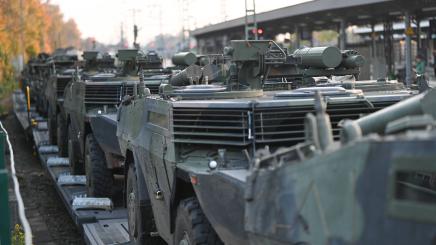
- At the top of the capabilities list are air and missile defense (AMD) systems as well as Intelligence, Surveillance and Reconnaissance (ISR) assets (including space based systems). There is also an urgent need for long-range fire systems to strengthen the deterrence and defense mission along the Alliance’s Northeastern frontier. In addition, armored personnel carriers as well as infantry fighting vehicles are needed, both of which Germany has at its disposal. Some of these capabilities, including air and missile defense assets, are supposed to be deployed to Lithuania as part of Germany’s decision to permanently station a brigade on its ally’s soil.
One should not count on Russia to wait until its armed forces are completely rebuilt
- Germany must also prepare to set further preparations in motion to preposition essential supplies and equipment in logistics hubs and enable a rapid response to any Russian aggression as well as operational resilience. The reason is that Russia, once a conflict becomes imminent, could use its air defense, artillery, and electronic warfare systems stationed in Kaliningrad as part of its A2/AD strategy to threaten NATO troop and materiel deployments to the Baltic States. In a war scenario, Moscow could block the narrow 65-kilometer wide Suwalki corridor connecting Poland and Lithuania, thereby delaying NATO reinforcements and potentially causing heavy losses for the Alliance. Consequently, and akin to what Berlin has committed itself to, Germany should nudge the other two framework nations in the Baltics, Canada and the United Kingdom, to permanently station brigades in Latvia and Estonia, respectively.
- Given that it is the full-scale war in Ukraine that is keeping Russia’s forces away from the Baltics, it is of essential importance for Germany to maintain – and, ideally, increase – the military support provided to Kyiv. This applies to bilateral and multilateral actions, including joint efforts in NATO and ‘coalition of the willing’ frameworks.
At the defense-industrial level:
- The German government must urgently address the bureaucratic hurdles that exist across the entire ecosystem of its defense industry. Selling weapon systems to the German armed forces continues to be significantly more complicated than sales to international customers. The National Security and Defense Industry Strategy (NSFIS) that was passed by the former German government in December 2024 contains several measures to simplify procedures, which is why its implementation should be prioritized by its successors.
- Germany should adopt a more European mindset by promoting minilateral cooperation formats in industrial collaboration instead of focusing overmuch on EU mechanisms, which are often slow and cumbersome. If manufacturing activities can be aligned across NATO and EU nations, duplication can be avoided. In any case, interoperability is critical for all defense systems sold to various nations and requires harmonizing system interfaces and technical standards.
- Germany should help Europe work towards regaining sovereignty over the entire supply chain system, which would safeguard both the resilience and strategic autonomy of Europe’s defense-industrial production in the long run. Similarly, export regulations across European countries need to be harmonized to create a more predictable and efficient framework for arms trade and industrial cooperation.